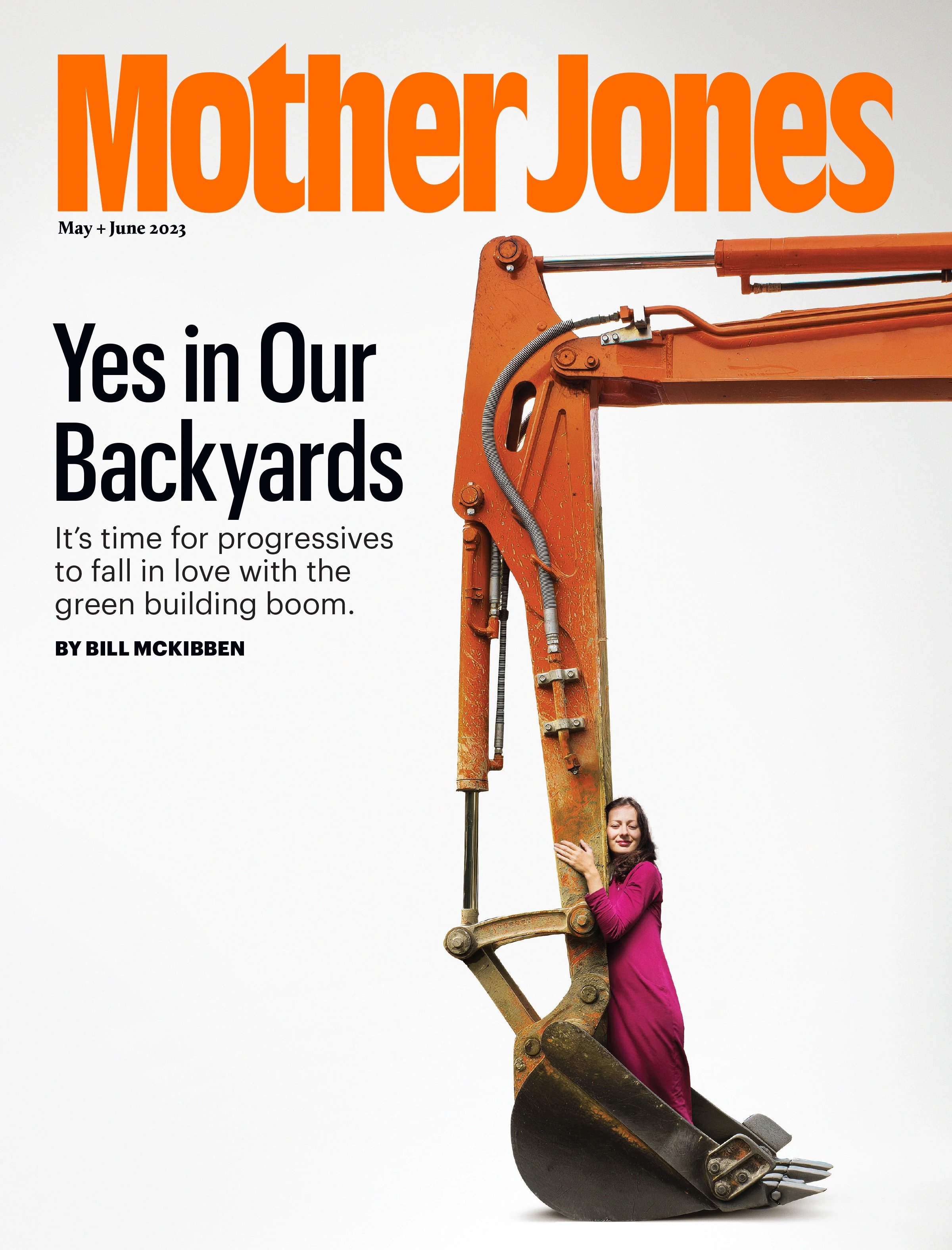
Given that the YIMBY/NIMBY thing is creeping (maybe even galloping!) into the discourse on urban planning and housing here in Australia, here’s a few thoughts on Bill McKibben’s new piece "Yes in our backyards" in Mother Jones, which seeks to offer some principles for when we should be saying “no” and when we should be saying “yes”…
McKibben sets up his argument by stating that while environmentalists have been good at saying ‘no’, the challenge of acting for a liveable climate will require us to get better at saying ‘yes’ to projects which will be required to reduce carbon emissions. For him, this must include new urban densification projects which contribute to decarbonisation. Undoubtedly, this articulation of 'yes in our backyard' by one of the world's most influential environmentalists will be picked up by the self-described YIMBY housing movement in cities in the US and beyond.
But if McKibben is worried about environmentalists hitching our wagon to 'not in my backyard' ('NIMBY') politics, I think we should be equally worried about hitching our wagon to a 'yes' in my backyard' ('YIMBY') politics. Rather than taking sides in the YIMBY/NIMBY debate as currently framed, we should be articulating and demanding an alternative way of deciding what needs construction and what needs conservation.
And while I think McKibben's piece and the principles he articulates could have made a contribution to that effort, it's likely to be mobilised in ways that reinforce the YIMBY/NIMBY debates in ways that contradict the very principles he's seeking to articulate.
McKibben starts with a simple premise: if a project makes climate change worse, we should still say no. But along with that, he offers four other principles for deciding when to say yes: "these factors, I think, should incline us toward supporting—perhaps grudgingly, and against our first impulse—new developments that address present crises and past injustice.”
They are:
1) We don’t live only in our backyard; we also share one. So, “protecting one’s backyard from any change has to be balanced against the cost it will impose on the larger whole”.
2) We don’t live only in our own moment—we’re accountable for past behavior. This applies especially to wealthy countries like US, who are responsible to more than their fare share of emissions in the past.
3) Idealism involves realism. So, even when new developments that cut carbon might have pernicious side effects (eg EVs reduce carbon but maintain car dependence and increase lithium mining), we have to figure out what an “acceptable level of realism looks like—not giving up the fight for systemic change, but also not letting lovely goals overwhelm the gritty needs.”
4) Emergencies demand urgency. He worries that “the general tactic used by the opponents of projects—delay it until it goes away—is in effect a form of climate denial.”
I’m already seeing McKibben’s article enthusiastically embraced and circulated by self-described YIMBYs in the local housing debate here in Australia, and I'm sure that's happening elsewhere too.
So, what does McKibben have to say about housing development, specifically?
While the focus is mostly on renewable energy projects like wind and solar farms, urban housing developments are among those used as examples of projects to which we should say ‘yes’. “Denser housing along transit corridors” is pitched as one of “the cheapest ways to cut carbon”, so “if we don’t build lots and lots and lots of projects like this, then we won’t be able to keep the temperature from climbing dramatically.”
No doubt that will be the quote that gets cited in YIMBY discourse. But if we dig a little deeper into what he’s saying, things get a bit more complicated.
In his next mention of housing, McKibben adds “affordable” to “denser”: he says we should be saying ‘yes’ to “new affordable housing that will make cities denser and more efficient while cutting the ruinous price of housing.”
However, as the article proceeds, he expresses some concern about the kind of opposition that says ‘no’ to density if it doesn’t involve affordability – in line with his third principle that idealism shouldn’t crowd out realism. He worries that good principles like affordability are sometimes being weaponised for bad purposes: “If someone who has never worked on affordable housing suddenly opposes a new development because it’s not 100 percent affordable, then that’s a tell.”
This leads him to join with those YIMBYs who argue that opposition to new housing projects is too often about protecting the assets of people who already own a home at the expense of those who do not: “If you figure out how to slow down a new housing project for four or five years, then the value of your home may go up, but someone else gets to live that four or five years under a bridge.”
He tempers this cynicism later, saying that the instinct to protect things doesn’t always come from a bad place: “that instinct can come from a good place. We’ve learned to love the world around us, and to value thriving urban neighborhoods; that’s been a core hope of environmentalists from the start, be they Aldo Leopold or Jane Jacobs.” But such values are reduced to aesthetic preferences, and he wants us to embrace a 'new aesthetic' that might appreciate a beauty in solar farms and housing for their contribution to making a liveable world.
In concluding his piece, McKibben recognises that these principles do not “infallibly spit out a default answer; every plan and project will be a little different”. For 'people of good faith' (which is the audience to which he explicitly appeals), this suggests that 'yes' should be a strong inclination, but not a dogmatic or uncritical position.
Indeed, those folks who enthusiastically embrace the principles McKibben is articulating here will need to carefully consider new housing projects on their merits, thinking through the application of principles rather than simply saying ‘yes’. Some of McKibben’s arguments and principles would still suggest that there are times when we might want to say ‘no’ to certain kinds of housing redevelopments, while saying ‘yes’ to others.
First, McKibben’s primary principle remains that we should say ‘no’ to projects that will make climate change worse. And the jury is still out on whether all forms of density actually do reduce emissions – some research suggests that other factors like wealth are equally as significant as density. And ‘density’ can be achieved in all manner of ways, with different climate impacts. So, it’s just not true that any and all densification will magically reduce emissions.
Second, there’s no question in my mind that there are people of bad faith among the ‘YIMBYs’ as well as the ‘NIMBYs’. The ‘YIMBY’ discourse is undoubtedly being amplified by people who are shilling for developers, who could not give a flying fuck about climate change or anything other than their profits, and who are weaponizing ‘sustainability’ and ‘affordability’ against anyone who dares to say ‘no’. To paraphrase McKibben with a twist, “if someone who has never worked on sustainability or affordability suddenly supports a new development on the grounds of sustainability or affordability, then that’s a tell.”
Third, McKibben himself notes that while historical responsibilities are vital, “history cuts both ways”: “Proposing new developments on, say, land that’s all that Native Americans have left of the continent they once possessed should warrant a much harder look; ditto for Black and Latino communities that have been systematically stuck with everything others don’t want.” Now apply this to our cities. There’s a growing research literature on ‘green gentrification’ showing that housing developments parading themselves as green sometimes actively displace and dispossess low-income communities and communities of colour from their neighbourhoods to make way for high-density, high-profit, high-cost housing. Opposing this is not just a matter of ‘idealism’. As environmental justice activists have been trying to say for decades, we’re just not going to build a world-changing movement for a liveable climate if the climate interventions for which we advocate are just more-of-the-same oppression for the many, and more-of-the-same benefits for the few.
So, to be honest, I really wish McKibben had framed his intervention differently – it’s addressed to people who say ‘no’ as if they are always the problem. Sometimes they are the problem. But sometimes they ain’t. In some ways, this could have been (and maybe still is?) a useful piece that seeks to offer some principles for discerning good 'YIMBY' from bad 'YIMBY', good 'NIMBY' from bad 'NIMBY'.
But by framing his piece as lending support to the YIMBYs over the NIMBYs, I fear McKibben won’t be read that way. Unfortunately, he’s taking a side in a debate that desperately, so desperately, needs to be reframed.
So here’s my pitch to McKibben and to his ‘people of good faith’ who have embraced the YIMBY position, and who like the principles that McKibben has articulated.
I’m sure many self-described YIMBYs are indeed people of good faith who really do care about sustainability and affordability, who see new housing projects as a vehicle for addressing both of those concerns, and who worry that opposition to such projects is more about ‘locals’ protecting their turf and their amenity. What might such people take out of McKibben’s piece?
On the general point that our pursuit of environmental and climate justice will involve building new stuff, let’s agree! In the Australian context, the idea that environmentalism involves construction as well as conversation is perhaps not so novel. After all, the Builders Labourers Federation representing construction workers were among our first environmentalists in the 1970s. While the BLF’s green bans were indeed a way to say ‘no’ to what they named ‘so-called developments’, the union also combined with residents to develop ‘people’s plans’ which were an assertive ‘yes’ to the construction of quality low-income housing in redevelopment areas.
But let’s also agree that both ‘no’ and ‘yes’ can come from ‘good’ and ‘bad’ places. In the case of housing, important principles of ‘sustainability’ and ‘affordability’ are certainly weaponised in bad faith by proponents, not just opponents, of new housing developments. New developments that espouse those principles too often have dubious climate benefits, and generate unjust displacements and dispossessions. (Indeed, among the examples of ‘red tape’ that the developers and some of their YIMBY friends frequently oppose here in Australia are regulations about sustainable materials and design, and mandated housing affordability targets!)
And so maybe we can also agree that if we do care about principles like addressing climate change, addressing historical injustices, and even being ‘realistic’ as well as ‘idealistic’ about how to build a powerful urban climate justice movement, our job is not simply to say ‘yes’ uncritically to every new housing development that promises density.
If we can agree on those things, here’s my final question for people of good faith: given the need to have principles for discerning between when we should say ‘yes’ and when we should say ‘no’, is a political rhetoric of polarisation between ‘NIMBY’ and ‘YIMBY’ actually going to make the cities we want, and the cities we need? Personally, I really don’t think so!
When low income people and people of colour fighting against the incursion of luxury ‘green’ density into their neighbourhoods are lumped together with wealthy white home owners fighting against public housing in their neighbourhoods as ‘NIMBYs’, do you really want to be ‘YIMBY’? Surely we should be seeking to disrupt the YIMBY/NIMBY distinction because it doesn’t capture the principles that are most important to us, rather than wielding it as a weapon?